


Ancient Roots. Independent Vision.
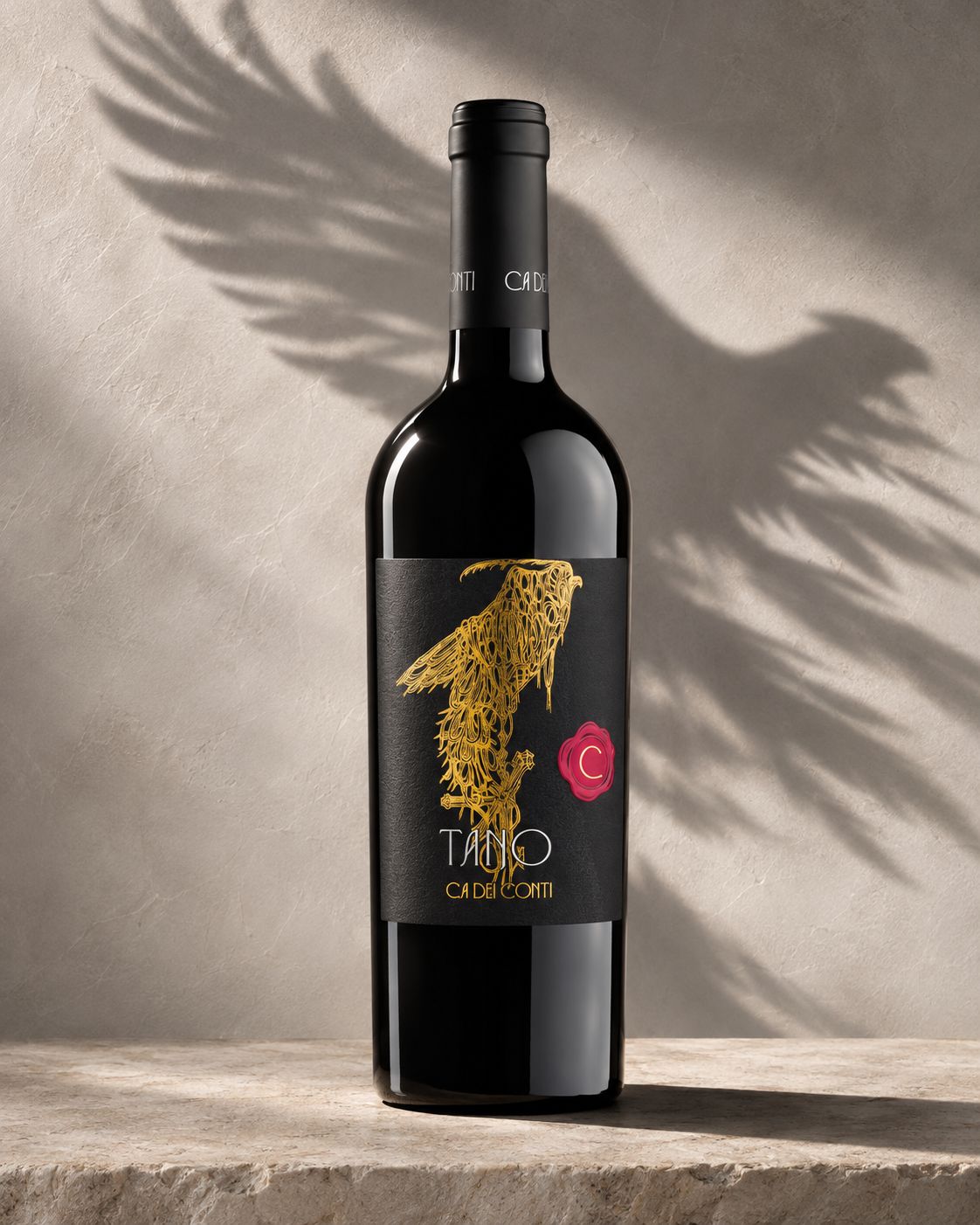
Among the hills of the province of Verona, Veneto, Italy, Tano interprets Amarone della Valpolicella through a vision that combines fidelity to tradition with the pursuit of a distinctive identity. Corvina, Corvinone and Rondinella meet Marzemino and Rebo in an assemblage that broadens the varietal expression of this historic appellation. Rather than seeking novelty for its own sake, this is a deliberate oenological choice, in which each variety contributes to a red wine of remarkable depth and individuality.
Its character takes shape through a deliberately patient process: three months of natural grape drying, carefully managed vinification and four years of maturation in American oak barriques, followed by at least a further year in bottle. Throughout this journey, the original concentration of the fruit develops into a more layered complexity, while time helps integrate structure, intensity and mature aromatic nuances. Tano thus embodies an interpretation of Amarone in which ageing is not merely a period of waiting, but a defining element of the wine's expressive architecture.
In the glass, Tano reveals a deep garnet-red colour and an aromatic profile interweaving sour cherry, ripe strawberry, dried fruit, cocoa and spices, supported by substantial structure and pronounced persistence. Its richness extends beyond the initial impression: as the wine opens, its evolving aromatic dimensions invite attentive tasting, revealing the relationship between fruit maturity, palate depth and the character imparted by extended ageing. An Amarone that needs no excess to assert its personality.
BEYOND* — Tano expresses a vision in which identity derives not merely from the prestige of its appellation, but from the coherence of recognisable varietal and winemaking choices. An independent interpretation of Veronese tradition, where time becomes the measure of complexity and originality is revealed through character rather than ostentation.
无法加载取货服务可用情况
PRIVATE ACCESS
Price & current availability
reserved for authorised access
REQUEST PRIVATE ACCESS


可折叠内容
Sensory profile
APPEARANCE
A deep, intense red, with ruby hues that may gradually develop garnet nuances through maturation. Its rich colour reflects the natural concentration achieved through grape drying, lending the wine a commanding visual presence. An appearance that introduces its generous structure without reducing the complexity of its character to colour intensity alone.
NOSE
The aromatic profile unfolds around a core of morello cherry, ripe cherry and strawberry, where the recognisable vitality of red fruit meets the greater depth imparted by the traditional drying process. Notes of dried fruit emerge alongside nuances of cocoa, vanilla and spices, extending the bouquet into warmer, more mature aromatic territory.
Tano's olfactory distinction lies in the interplay between these dimensions: the fruit retains its individual presence alongside the more evolved notes, preventing aromatic richness from becoming an undifferentiated expression of concentration. The result is a broad, layered bouquet in which maturation contributes depth without obscuring the original character of the grapes.
PALATE
The opening is expansive, warm and enveloping, supported by concentrated fruit and a notably supple texture. Ripe fruit occupies the centre of the palate, while spicy impressions and nuances associated with maturation progressively broaden its complexity.
At 17% alcohol by volume, Tano possesses considerable weight and intensity, yet its expression extends beyond sheer power. The declared total acidity of 7.2 g/L provides a significant structural counterpoint to the wine's richness, while 6 g/L of residual sugar forms part of its overall composition without defining a sweet style.
The resulting palate is substantial and persistent, bringing together concentration, warmth and expressive depth in a wine that rewards attentive tasting and an appreciation of the relationship between strength and complexity.
BALANCE & STRUCTURE
Tano's structure is built upon an intricate balance of naturally powerful elements: concentrated fruit, full body, substantial alcoholic weight and an acid component that offers an essential counterpoint to its richness.
Extended grape drying contributes to the density of the fruit, while prolonged oak maturation and subsequent bottle ageing support the development of a more mature, layered texture. The suppleness identified in specialist tasting descriptions interacts with the wine's considerable structural presence, creating an expression of generosity that cannot be explained by opulence alone.
Here, balance has a particular meaning: not lightness, but proportion among inherently intense components, allowing the wine's personality to emerge without being defined by any single element.
EVOLUTION IN THE GLASS
Tano invites a gradual approach, allowing time in the glass to bring its different aromatic dimensions into clearer focus.
Cherry, morello cherry and strawberry may initially occupy the foreground, while dried fruit, cocoa, vanilla and spices can become more apparent as the wine opens. Rather than following a fixed sequence, these impressions may shift in prominence, offering a progressively more nuanced understanding of the bouquet.
With older vintages, this evolution deserves particular attention. Serving temperature, exposure to air and bottle condition can significantly influence aromatic development. A generously proportioned glass and unhurried tasting provide the opportunity to explore these nuances without imposing a predetermined aeration period.
FINISH
The finish is long and persistent, maintaining a sense of continuity consistent with the wine's full body and pronounced aromatic intensity. Ripe fruit remains an important reference point, accompanied by spicy nuances and cocoa impressions, while the fresher component contributes definition to the concluding expression.
Persistence is not merely a question of how long sensations remain, but of how clearly they retain their individual character after the wine has left the palate. This relationship between breadth, aromatic maturity and continuity is among Tano's most compelling sensory attributes.
SENSORY IDENTITY
Tano's sensory identity emerges from the meeting of a deeply established Valpolicella tradition and a particularly distinctive varietal composition.
Corvina, Corvinone, Rondinella, Marzemino and Rebo come together in an assemblage whose complexity is developed through grape drying and extended maturation. Rich red-fruit aromas, mature nuances and generous structure create a recognisable profile that reaches beyond the most conventional expressions associated with Amarone.
Its defining characteristic is the relationship between concentration and complexity: an intense wine whose aromatic diversity, supple texture and underlying acidity allow it to express a personality more nuanced than power alone.
SERVING TEMPERATURE
16–18°C. | 61–64°F.
Serve in a large, generously proportioned fine red-wine glass, ideally with a broad bowl that allows its different aromatic dimensions to develop and become more readily perceptible.
A carefully controlled serving temperature helps moderate the prominence of alcohol while preserving greater fruit definition and the more delicate nuances of the bouquet.
For older vintages, assess the need for decanting individually, taking account of possible sediment and the bottle's stage of development. Extended aeration should not be applied indiscriminately to wines of different ages.
BEYOND* INTERPRETATION
True intensity is not what dominates the glass, but what succeeds in preserving an identity of its own.
Tano explores this relationship through a journey in which fruit is concentrated, structure transformed and time becomes central to the development of complexity. The presence of Rebo and Marzemino alongside the denomination's established varieties introduces an element of independent interpretation into a deeply recognisable winemaking tradition.
For BEYOND*, its significance lies neither in the pursuit of maximum power nor in the duration of maturation alone. It lies in the possibility of recognising, within such abundant richness, a coherent relationship between varietal origins, maturation, aromatic depth and character.
An expression of tradition that retains the freedom to speak in its own voice.
Food pairings & tasting suggestions
Origin, vineyard & terroir
Production method & ageing
Ingredients, nutritional information & packaging specifications
Producer history & wine identity
Availability, allocation & rarity
Certifications, awards & medals
DESIGNATION OF ORIGIN — AMARONE DELLA VALPOLICELLA DOCG
Denominazione di Origine Controllata e Garantita (DOCG) — Controlled and Guaranteed Designation of Origin
Tano belongs to the prestigious Amarone della Valpolicella DOCG appellation, rooted in the winemaking heritage of the province of Verona, Veneto, Italy.
The designation safeguards a distinctive wine identity closely connected to its geographical origins and the traditional practice of drying selected grapes, establishing requirements governing origin, production and wine characteristics.
ORGANIC VITICULTURE — EUROPEAN CERTIFICATION
CCPB · IT-BIO-009 | Organic Farming
Cà dei Conti integrates organic viticulture into its production philosophy, placing particular emphasis on the preservation of natural resources, biodiversity and responsible vineyard management.
The estate presents European organic certification credentials associated with CCPB, the Italian control body identified by code IT-BIO-009. For Tano, the organic certification programme applies to production from the 2021 vintage onwards.
VEGAN CERTIFICATION — CERTIFICATO VEGANO
Certificato Vegano | Estate Credentials
Cà dei Conti displays the Certificato Vegano mark among its estate credentials, reflecting attention to winemaking practices and processing aids compatible with vegan production requirements.
FIVI — ITALIAN FEDERATION OF INDEPENDENT WINEGROWERS
Cà dei Conti | FIVI Independent Winegrower
Cà dei Conti is a member of FIVI, the Italian Federation of Independent Winegrowers, an organisation representing producers directly engaged in cultivating their vineyards, vinifying their own grapes, bottling and marketing their wines.
FIVI membership highlights independent production, the winegrower's direct responsibility and the connection between territory, artisanal craftsmanship and wine identity.
SLOW WINE — EDITORIAL RECOGNITION OF THE ESTATE
Cà dei Conti | Slow Wine
The estate is recognised within the Slow Wine editorial project, which places particular emphasis on the relationship between wine, territory, viticultural practices and environmental responsibility.
Cà dei Conti's presence reflects a production philosophy attentive to sustainability, the preservation of viticultural heritage and the artisanal dimension of winemaking.
WINE AWARDS, MEDALS & RECOGNITIONS
2025 — THE WINEHUNTER AWARD COLLECTION
Tano 2017 | Amarone della Valpolicella DOCG
Included in the official The WineHunter Award Collection 2025, as part of the wine evaluations associated with the Merano WineFestival.
2024 — THE WINEHUNTER AWARD | RED MEDAL
Tano 2014 | Amarone della Valpolicella DOCG
WineHunter Award Red recognition attributed to the 2014 vintage in the 2024 edition.
2023 — THE WINEHUNTER AWARD | RED MEDAL
Tano 2013 | Amarone della Valpolicella DOCG
WineHunter Award Red recognition attributed to the 2013 vintage in the 2023 edition.
2017 — TOP HUNDRED | ILGOLOSARIO
Tano 2012 | Amarone della Valpolicella DOCG
Selected among the Top Hundred 2017 by Paolo Massobrio and Marco Gatti, an editorial recognition celebrating one hundred Italian wines distinguished by their quality and identity, presented as part of Golosaria.