


Some wines reveal a territory through landscape. Others do so through a grape variety that belongs almost exclusively to that place.
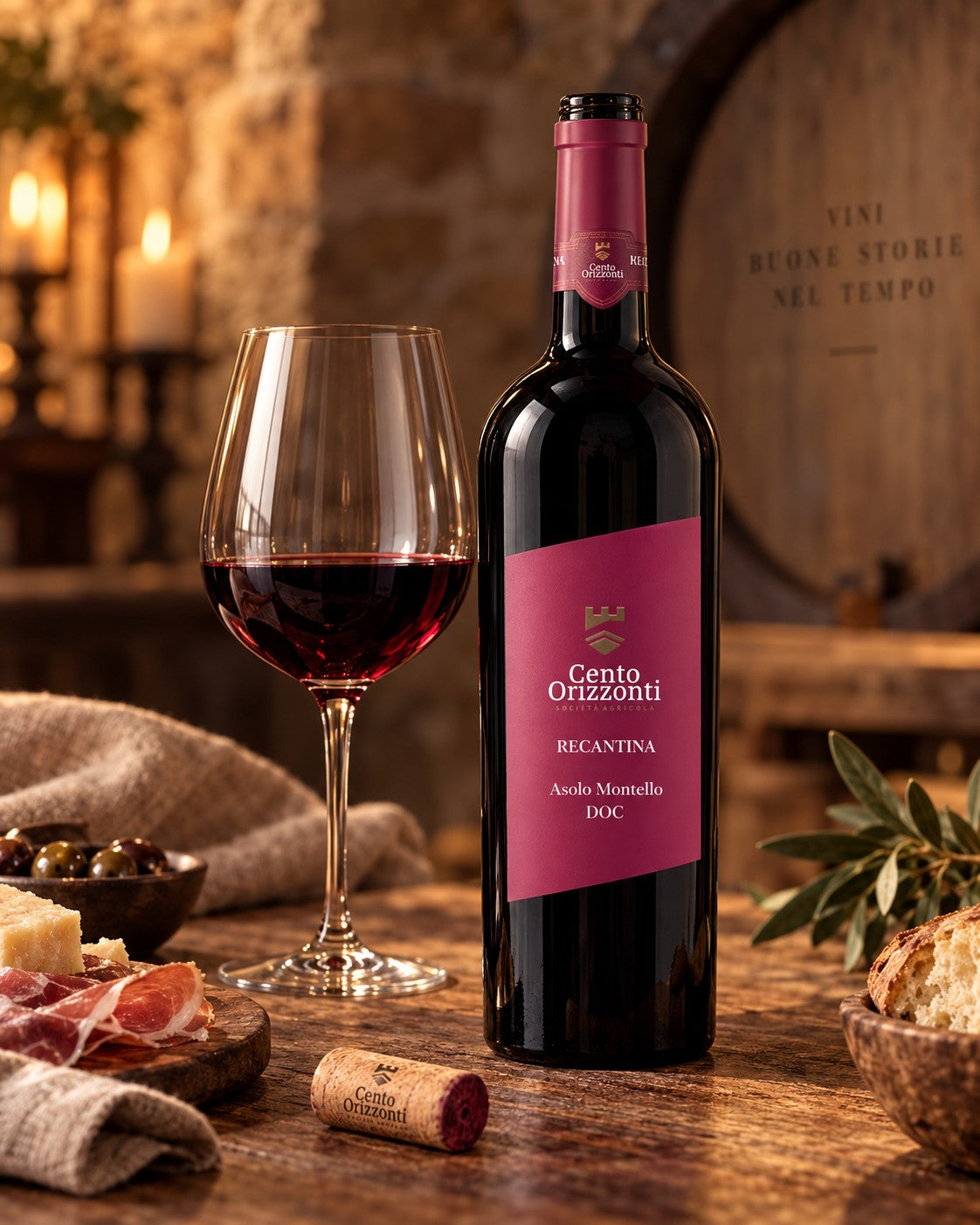
Cento Orizzonti is produced entirely from Recantina, one of the native red varieties most closely associated with the hills of Asolo and Montello, where Progress Country & Wine House cultivates its own vineyards.
Here, Recantina is not treated as a historical curiosity, but as a wine with an identity of its own. Vinified in purity and matured for 18 months, it offers a direct interpretation of a variety whose character is inseparable from this part of the Treviso hills.
Its significance lies precisely in that relationship: a local grape, grown within its traditional territory and given sufficient time to develop without being absorbed into a broader blend or stylistic formula.
For BEYOND*, Cento Orizzonti represents a wine whose distinction begins with origin itself — a contemporary expression of one of Asolo Montello’s most recognisable native red identities.
Not different by intention. Distinct by nature.
受取状況を読み込めませんでした


折りたたみ可能なコンテンツ
Sensory profile
APPEARANCE
A clear, vivid red appearance, consistent with the varietal character and the wine’s measured, contemporary style.
AROMATIC PROFILE
The nose opens on ripe red fruit, expressive but never overripe, accompanied by subtle spicy nuances and an overall sense of clarity and balance.
ON THE PALATE
Recantina reveals one of its most distinctive traits through freshness, tension and a dynamic progression. The fruit remains well defined, while the structure is present without becoming heavy or over-extracted.
FINISH
The finish is clean, persistent and balanced, with freshness carrying the wine through the final phase and preserving the precision of its varietal expression.
OVERALL BALANCE
The wine shows a convincing equilibrium between fruit maturity, freshness, structure and depth. The 18-month ageing supports the wine without masking the character of the grape.
DISTINCTIVE CHARACTER
For BEYOND*, the defining strength of Cento Orizzonti lies in its ability to preserve identity, tension and territorial character. It is a Recantina with a measured yet recognisable personality, allowing the variety to speak clearly without stylistic overstatement.
An indigenous red voice — precise, contemporary and deeply rooted in Asolo Montello.
Food pairings & tasting suggestions
SERVING TEMPERATURE
Serve at 16–18°C./ 61–64°F., avoiding excessively warm temperatures that could soften the wine’s freshness and tension.
RECOMMENDED GLASSWARE
A generously sized red wine glass with good vertical development, allowing sufficient aeration while preserving aromatic precision and definition.
FOOD PAIRINGS
The combination of freshness, tension and measured fruit ripeness makes Cento Orizzonti particularly versatile at the table.
It pairs well with:
>roasted or grilled red meats;
>braised dishes and slow-cooked meats;
>duck and structured white meats;
>filled pasta and pasta dishes with meat ragù;
>mushrooms, radicchio and earthy preparations;
>moderately aged cheeses.
Its natural freshness also allows it to accompany flavourful dishes without making the overall experience feel heavy.
TASTING MOMENT
Best enjoyed at the table, particularly with dishes that offer structure without overwhelming the wine.
It can also be appreciated on its own, allowing it to open gradually in the glass and reveal the evolution of its aromatic profile and freshness.
BEYOND* SUGGESTION
Opening the bottle 20–30 minutes before serving can help the wine express its fruit, subtle spice and natural tension with greater clarity.
Cento Orizzonti does not require elaborate cuisine to show its character: it performs best when the food leaves space for its varietal identity and the freshness that defines Recantina.
Origin, vineyard & terroir
ORIGIN
Italy, Veneto, province of Treviso, Asolo and Montello area, within the territorial context historically associated with the Recantina grape variety.
The setting is that of the Asolo Hills and Montello, a hilly system characterised by articulated slopes, varied exposures and a landscape where vineyards alternate with agricultural land and wooded areas.
The wine therefore originates from one of the most distinctive territorial systems of the Treviso foothills, with a strong viticultural identity and a historical connection to indigenous grape varieties.
VINEYARDS
Progress Country & Wine House cultivates approximately 9 hectares of vineyards distributed across five vineyard sites on the hills of Asolo.
The vineyards are located in a favourable hilly environment, where exposure, slope and natural ventilation contribute to maintaining balance between ripeness, freshness and aromatic definition.
For Cento Orizzonti, the vineyard component is particularly relevant because the wine is intended to express the identity of Recantina within its native territorial context.
SOIL
The estate vineyards are characterised by soils with calcareous, rocky and clay components.
This combination contributes to drainage, structural balance and the preservation of freshness, while the clay fraction supports water retention and gradual vine development during the growing season.
The interaction between these different soil components forms part of the structural basis of the wine’s territorial expression.
GRAPE VARIETIES
100% Recantina.
Recantina is an indigenous red grape variety closely associated with the Asolo and Montello area and represents one of the most distinctive elements of the local viticultural heritage.
Its use as a single variety allows Cento Orizzonti to preserve a clear and recognisable varietal identity rather than relying on blending or stylistic construction.
VINEYARD MANAGEMENT
The vineyards are managed within the broader agricultural system of Progress Country & Wine House, with attention to the relationship between vineyard site, grape ripeness and the preservation of natural freshness.
Available information confirms the estate context and vineyard distribution, while more detailed data regarding individual parcels, vine age, training systems and vineyard-by-vineyard management remain areas for further technical verification.
For BEYOND*, this distinction is important: the wine is valued on the basis of documented territorial coherence, without attributing unverified vineyard-specific details.
TERRITORIAL IDENTITY
The identity of Cento Orizzonti is built around the direct relationship between Asolo-Montello, Recantina and the local hillside environment.
Its significance does not come from stylistic excess, but from the continuity between an indigenous grape variety and the territory in which it has historical relevance.
For BEYOND*, this makes Cento Orizzonti particularly representative of a territorial wine: a red wine whose value lies in the legibility of the chain origin → vineyard → soil → grape variety → wine.
A native grape. A defined territory. A red identity rooted in Asolo Montello.
Production method & ageing
HARVEST & GRAPE PREPARATION
Cento Orizzonti is produced exclusively from Recantina, an indigenous red grape variety historically linked to Montello and the Asolo Hills.
Recantina is a relatively late-ripening variety, naturally characterised by a significant phenolic content and good ageing potential. These traits make the balance between ripeness, freshness and structural development particularly important at harvest.
FERMENTATION & MACERATION
Recantina is vinified as a single-varietal still red wine, with the aim of preserving the grape’s identity and its natural combination of freshness, structure and spice.
Progress Country & Wine House operates with a cellar equipped with concrete vats, stainless-steel tanks, wooden vats, CO₂ control systems, a destemmer-crusher and double-bladder pressing equipment. These elements define the technical environment in which the estate’s winemaking takes place.
AGEING
The production element explicitly stated by the producer is ageing in barrique.
In the case of Recantina, the use of oak is particularly significant because it interacts with a grape variety naturally endowed with structure and ageing potential.
EVOLUTION & INTEGRATION
Ageing accompanies the evolution of Recantina towards greater integration between fruit, structure and spice.
BEYOND*’s tasting of Cento Orizzonti showed a wine in which ripe red fruit remains measured, freshness retains tension and varietal character remains clearly legible without being weighed down by ageing.
An interesting precedent also appears in WineMag’s review of the first 2021 trial, which described a wine driven by acidity, with a spicy component and a finish marked by savoury and lightly bitter notes.
PREPARATION & BOTTLING
The wine is released in 0.75 l bottles with a glass bottle and natural cork closure.
RESIDUAL SUGAR
0 g/l.
The official data therefore confirm a fully dry expression of Recantina, with no residual sugar altering the perception of freshness, structure or savoury character.
VITICULTURAL CONTEXT
The most recent technical documentation from Progress Country & Wine House indicates that the viticulture associated with Cento Orizzonti is currently undergoing organic conversion.
This element sits within a broader agricultural project in which the estate works with Recantina, Glera and Pinot Nero while integrating wine production with the wider agricultural landscape.
The organic conversion should therefore be viewed as part of an evolving project, to be followed over time in relation to any future certification effectively obtained.
PRODUCTION PHILOSOPHY
Understanding Cento Orizzonti means looking beyond cellar technique alone.
Recantina is documented in the territory at least as far back as 1697, when Giacomo Agostinetti cited it among the noteworthy grape varieties cultivated in the Treviso area. After nearly disappearing following phylloxera, it was recovered and reintroduced through the work of local producers and institutions; today it is regarded as the only indigenous red grape variety of Montello to have survived into the contemporary era.
In this context, producing a 100% Recantina wine is not simply an oenological choice: it means restoring a grape variety that belongs to the viticultural memory of Asolo and Montello.
For BEYOND*, the production method gains value precisely when technique remains subordinate to identity. Barrique can support the wine’s evolution, but it should not replace the character of the grape; vinification should make Recantina more legible, not transform it into a stylistically interchangeable red wine.
A recovered grape variety. A vinification that accompanies its evolution. A technique that remains subordinate to territorial identity.
Ingredients, nutritional information & packaging specifications
INGREDIENTS
Grapes.
Cento Orizzonti is produced from 100% Recantina, an indigenous grape variety from the Asolo and Montello area.
ALLERGENS
Contains sulphites.
NUTRITIONAL VALUES
Values per 100 ml:
Energy: 356 kJ / 85 kcal
Carbohydrates: 0.2 g
of which sugars: 0.2 g
Protein: 0.1 g
Fat: 0 g
of which saturates: 0 g
Fibre: 0 g
Salt: 0 g
ANALYTICAL DATA
Alcohol: 13% vol.
Type: still red wine
Denomination: Recantina Asolo Montello DOC
Grape variety: 100% Recantina
Format: 0.75 l
CONTAINER SPECIFICATIONS
Format: 0.75 l
Bottle: brown glass
Closure: cork
Capsule: PVC
Cento Orizzonti is also available in 1.5 l Magnum format.
PACKAGING DISPOSAL
Brown glass bottle → GLASS
Cork → ORGANIC WASTE
PVC capsule → PLASTIC
Labels are disposed of together with the bottle.
Always check your local recycling regulations.
Producer history & wine identity
GEOGRAPHICAL ORIGIN & NATURAL CONTEXT
Progress Country & Wine House was established in Asolo, in the Treviso hills, in a panoramic position at approximately 200 metres above sea level, surrounded by vineyards and olive groves and set behind the seventeenth-century Villa Rinaldi.
It is a landscape where agriculture, history and culture coexist in a particularly distinctive way: from the Rocca di Asolo, the view extends across the Venetian plain towards Venice and Monte Grappa, within the town famously described by Giosuè Carducci as “the city of a hundred horizons.”
The estate today comprises approximately 9 hectares of vineyards distributed across the Asolo hills, in an environment characterised by calcareous, rocky and clay soils and climatic conditions favourable to viticulture.
ORIGINS OF THE PROJECT & ENTREPRENEURIAL CONTINUITY
Progress Country & Wine House was founded through the initiative of Venetian entrepreneurs Dennis Bordin, his wife Beatrice, Fanio Pontin and his family, with the stated ambition of enhancing Asolo through a project capable of bringing together landscape, agriculture, wine, olive oil and hospitality.
From the outset, the estate was conceived not simply as a winery, but as an agricultural and hospitality project in which the product becomes part of a broader experience of the territory.
Vineyards, olive groves, winery, tasting and hospitality are therefore integrated within a single vision: not simply to produce in Asolo, but to make Asolo understandable through what is cultivated and experienced there.
THE TURNING POINT
A decisive stage in the development of the project came with direct investment in wine production and the creation of a technologically modern winery, designed according to contemporary criteria and equipped with concrete vats, stainless-steel tanks and wooden vessels, together with dedicated systems for the different stages of vinification.
At the same time, the move towards organic viticulture and greater attention to the relationship between vine, soil and environment became one of the declared pillars of the estate’s philosophy. Progress describes this approach as a choice aimed at building a balanced agricultural ecosystem and a form of production more closely aligned with the territory.
The estate’s progressively established presence at Vinitaly, ProWein and Wine Paris also reflects its evolution from a strongly local project towards presentation in international professional contexts.
PRODUCTION VISION
The vision of Progress Country & Wine House is built around the relationship between territory, agriculture and product.
Its range extends beyond Glera and Asolo Prosecco Superiore DOCG: alongside Col del Sol and Col d’Acelum, Recantina has an important place, together with Pinot Nero and DOP del Grappa olive oil. The winery identifies Cento Orizzonti as one of its representative wines alongside its sparkling wine production.
This diversity allows the project to interpret the Asolo hills not through a single wine style, but through different expressions of the same territory: the sparkling vocation of Glera and, on the red side, the recovery of an indigenous variety such as Recantina.
ORIGIN & IDENTITY OF THE WINE
Cento Orizzonti was created as a single-varietal interpretation of Recantina Asolo Montello DOC, an indigenous red grape deeply connected to the viticultural history of Montello and the Asolo Hills.
The winery’s first documented trial dates to the 2021 vintage, presented and tasted within the context of the contemporary rediscovery of Recantina. WineMag described it as Progress’s first experience with the variety, highlighting its acidity, spice, savoury character and personality.
By 2022, Cento Orizzonti was already being presented by the estate as a new label during public events held among the vineyards, while the 2022 vintage subsequently appeared in territorial tastings organised along the Asolo and Montello Wine Route.
The name Cento Orizzonti also establishes an immediate connection with the cultural identity of Asolo, internationally known as the “city of a hundred horizons.” The name therefore strengthens the relationship between wine and place without reducing the wine’s identity to the grape variety alone.
The choice of 100% Recantina combined with barrique ageing gives the wine a precise position within the Progress range: not simply the red counterpart of a winery focused on Prosecco, but a second territorial voice capable of expressing a different yet complementary part of Asolo-Montello’s varietal heritage.
CONTINUITY & COHERENCE
The continued presence of Cento Orizzonti within the range, its availability also in Magnum format, its participation in territorial tastings and the progressive consolidation of Recantina within the estate’s identity demonstrate that the wine has moved beyond the stage of initial experimentation.
Its coherence should be understood above all through its relationship with the wider Progress project: creating value from the Asolo territory through grape varieties, agriculture, landscape and local culture.
If Col del Sol expresses one of the most recognisable interpretations of Asolo’s sparkling wine vocation, Cento Orizzonti represents its indigenous red counterpart.
Two wines differing in grape variety and style, yet built around the same intention: to make territory not a narrative backdrop, but the very reason for the wine’s existence.
BEYOND* IDENTITY
For BEYOND*, Cento Orizzonti has particular value because it adds a less immediate and rarer dimension to the understanding of Asolo.
Recantina moves the perspective beyond the territory’s international association with Glera and brings back into focus a red grape variety that belongs to the area’s viticultural memory.
Within Progress Country & Wine House, the wine also reveals a particularly compelling coherence: the same territory, the same entrepreneurial project, yet an entirely different voice.
It is precisely this ability to broaden the understanding of a place that makes Cento Orizzonti relevant to the BEYOND* selection: not difference pursued as a stylistic exercise, but the rediscovery of an identity already embedded in the territory and brought back to the foreground through wine.
Not different by intention. Distinct by nature.
Availability, allocation & rarity
LIMITED PRODUCTION
Cento Orizzonti belongs to a naturally limited production context, linked to one of Veneto’s rarest indigenous red grape varieties.
Recantina occupies an extremely small vineyard surface within the Asolo and Montello area. The limited extent of this varietal heritage places the wine in a completely different production scale from Veneto’s major grape varieties.
Its rarity therefore does not come from an artificial scarcity strategy, but from the naturally limited availability of the grape variety from which it is produced.
AVAILABILITY
The current availability of Cento Orizzonti is approximately 1,500 bottles.
This remains an accessible quantity, but one sufficiently limited to make availability management relevant, particularly for multiple-bottle orders, professional requests or purchases intended for ageing.
The wine is available in 0.75 l bottles and, in dedicated quantities, in 1.5 l Magnum format.
BEYOND* ALLOCATION
BEYOND* manages Cento Orizzonti within its selection through an allocation approach based on actual bottle availability.
The purpose is not to create artificial scarcity, but to preserve continuity, clarity in order management and access to the wine for as long as the available vintage remains in stock.
For professional enquiries, larger quantities or special formats, allocation is assessed according to current availability.
RESERVATION RECOMMENDED
With current availability at approximately 1,500 bottles, reservation is recommended for:
>multiple-bottle orders;
>purchases intended for selected restaurants or hospitality;
>international enquiries;
>Magnum format;
>purchases intended for ageing or cellar development.
Reservation allows BEYOND* to confirm actual availability and ensure proper allocation before the available vintage is sold out.
RARITY
The true rarity of Cento Orizzonti begins with Recantina itself.
It is an indigenous grape variety historically rooted in Montello and the Asolo Hills, recovered after coming close to disappearance and today cultivated on an extremely limited surface.
Its rarity is therefore simultaneously:
>Varietal — only a very small vineyard area is planted with Recantina;
>Territorial — cultivation remains strongly concentrated within its historical Asolo and Montello environment;
>Cultural — the variety belongs to the area’s viticultural memory and was recovered after nearly disappearing;
>Productive — overall quantities remain naturally limited compared with major Italian grape varieties and denominations.
For BEYOND*, this combination is what gives Cento Orizzonti particular significance: a bottle that is still accessible today, yet originates from an exceptionally restricted viticultural heritage.
Rare not because it has been made difficult to find. Rare because it can only come from such a limited varietal heritage, deeply rooted in its territory.
Certifications, awards & medals
CERTIFICATIONS
Recantina Asolo Montello DOC.
The most recent technical documentation from Progress Country & Wine House indicates that the viticulture associated with Cento Orizzonti is currently undergoing organic conversion.
This places the wine within the estate’s broader commitment to an agricultural approach increasingly focused on the relationship between vineyard, environment and territorial identity.
SELECTED FOR VINIBUONI D’ITALIA 2024
Progress Country & Wine House’s Recantina Asolo Montello DOC was selected for inclusion in the 2024 edition of Vinibuoni d’Italia, the Touring Club Italiano guide dedicated specifically to wines produced from indigenous Italian grape varieties.
The recognition is particularly significant for Cento Orizzonti because the guide’s focus on native grapes corresponds directly with the identity of Recantina: a rare indigenous red variety historically rooted in Asolo and Montello.
AMERICA AWARDS
2023 — SILVER AWARD
Cento Orizzonti Recantina Asolo Montello DOC received a Silver Award at the America Awards 2023, as reported in the official technical documentation issued by Progress Country & Wine House.
The award introduces Recantina into an international evaluation context and gives visibility beyond Italy to a grape variety whose production remains closely concentrated within its historical territory.
For a wine built around such a limited indigenous varietal heritage, this recognition has particular relevance: it brings an intensely local identity into an international professional context.