


A Dialogue Between Freshness and Structure
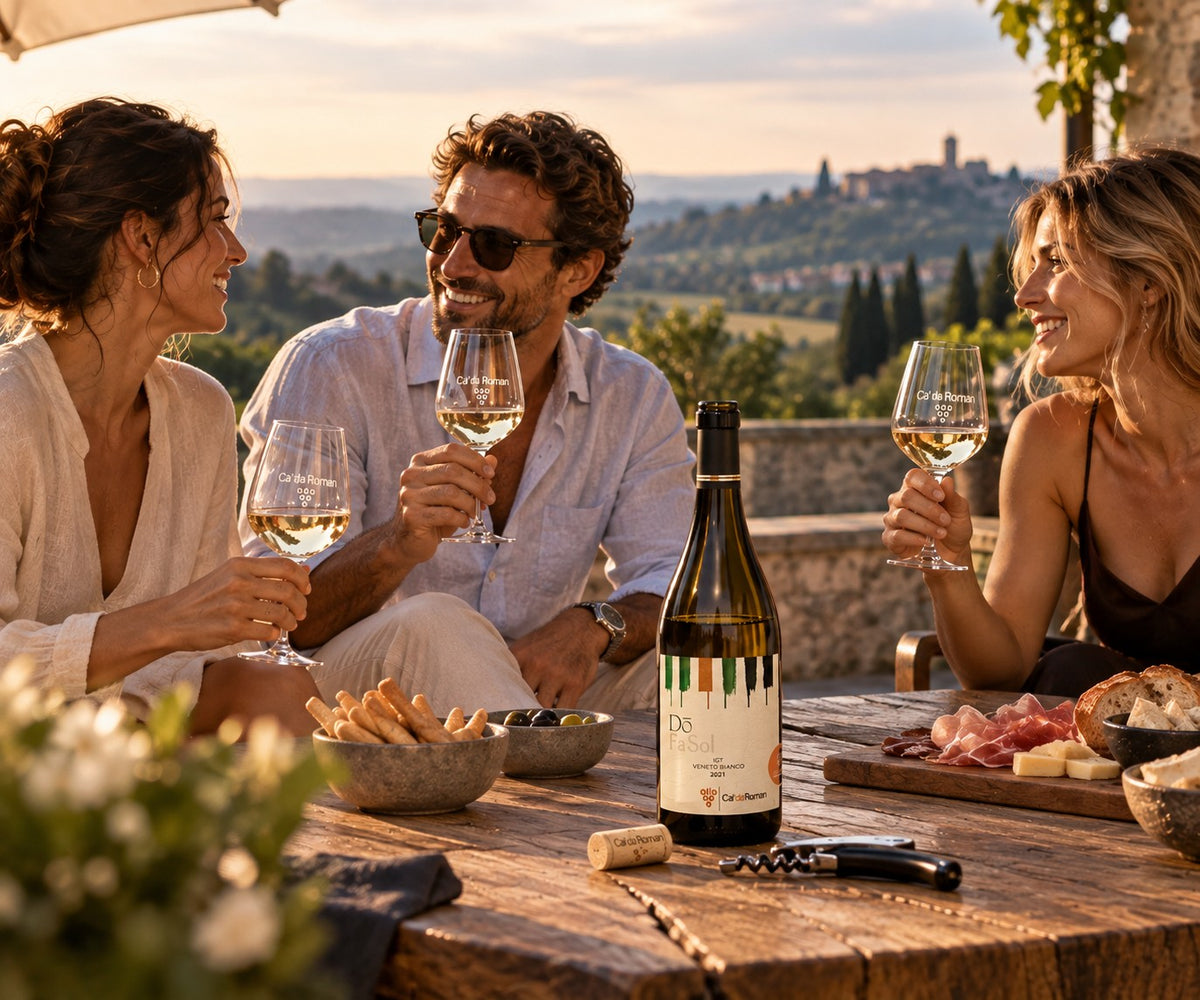
Dō Fa Sol is Ca’ da Roman’s distinctive interpretation of two complementary PIWI varieties: Bronner and Johanniter. The former brings freshness, sapidity and energy; the latter contributes depth, structure and breadth, creating a white wine whose identity emerges from balance rather than contrast.
Produced in Romano d’Ezzelino, at the foothills of Monte Grappa in Veneto, northern Italy, the wine reflects mineral-rich clay-loam soils and Ca’ da Roman’s organic, forward-looking approach to resistant grape varieties. Its place within the Ca’ Apollonio Heritage estate connects contemporary viticulture with a broader landscape of agricultural and historical identity.
On the palate, vibrant acidity meets a warmer, almost gently sweet structural impression. Full-bodied and characterful, Dō Fa Sol evolves progressively in the glass, revealing an intriguing combination of freshness, substance and composed complexity that naturally invites a second taste.
Aged for ten months in French barriques on fine lees, with frequent stirring, the wine gains texture and depth without losing precision. Under the direction of Nicola Biasi, Bronner and Johanniter become a confident expression of organic Veneto Bianco IGT: unconventional in composition, harmonious in character and distinctly gastronomic.
Two varieties. One distinctive harmony.
Couldn't load pickup availability

Collapsible content
Sensory profile
APPEARANCE
Bright straw yellow, with golden reflections that anticipate a certain richness of texture. The wine remains visually precise and luminous, consistent with a structured white that retains freshness and definition.
NOSE
The aromatic profile is broad and layered. Initial notes of peach, pear and apricot are followed by riper, more exotic nuances of pineapple and mango. Floral tones bring hints of acacia and orange blossom, while the citrus register develops toward grapefruit and candied peel.
Barrel ageing adds a second dimension, introducing notes of butter biscuit, white chocolate, light toast and a subtle smoky touch, while preserving the freshness of the fruit.
PALATE
On the palate, Dō Fa Sol shows body, breadth and character, yet without allowing weight to overpower freshness. The acidity is well integrated and works together with a warmer, rounder and almost sweet tactile sensation, despite the very low residual sugar. Johanniter contributes depth and volume, while Bronner keeps the wine lively, energetic and savoury. ca.da.roman.dofasol.scheda
The texture is creamy without becoming heavy, supported by pronounced minerality and a progressively saline character that lightens the mid-palate and extends the finish.
BALANCE & STRUCTURE
One of Dō Fa Sol’s most distinctive features is the controlled contrast between freshness and warmth, tension and volume, savouriness and softness. It is neither a strictly vertical white nor a wine dominated by oak. The French barrique mainly shapes texture and complexity, while fruit and mineral definition remain clearly visible.
This dual nature is what gives the wine much of its gastronomic versatility and recognisable character.
EVOLUTION IN THE GLASS
Dō Fa Sol is a wine that develops progressively with aeration. Its initial freshness and citrus-driven character gradually open toward riper, creamier, balsamic and lightly toasted notes. Time in the glass allows the wine to reveal greater aromatic depth and textural complexity.
For this reason, it should not be served excessively cold: a slightly higher temperature allows the wine to express its full aromatic and structural range.
FINISH
The finish is savoury, gently saline and persistent, with returning notes of ripe citrus, yellow fruit and subtle pastry nuances. The close remains dry and composed, with mineral tension preventing the warmer, creamier elements from becoming heavy.
SENSORY IDENTITY
Dō Fa Sol does not rely on a single dominant register. Its personality emerges from the interaction of:
ripe fruit → floral notes → citrus → creaminess → minerality → salinity → oak-derived depth
The result is a full-bodied, gastronomic and progressive white, combining the freshness of Bronner with the structure of Johanniter while integrating barrel ageing without sacrificing precision.
BEYOND* INTERPRETATION
For BEYOND*, the sensory value of Dō Fa Sol lies in its ability to avoid extremes. It is neither a PIWI wine built solely around freshness nor an oak-aged white defined by power. Its identity instead comes from the harmony of contrasts:
-freshness + structure
-acidity + roundness
-fruit + oak
-substance + savouriness
It is this progressive balance, rather than any single dominant aroma, that makes Dō Fa Sol genuinely distinctive.
Food pairings & tasting suggestions
Origin, vineyard & terroir
Production method & ageing
Ingredients, nutritional information & packaging specifications
INGREDIENTS
Wine made from Bronner and Johanniter grapes, PIWI varieties grown according to the principles of organic farming.
Preservative and antioxidant: potassium metabisulphite.
ALLERGENS
Contains sulphites, deriving from the use of potassium metabisulphite as preservative and antioxidant.
NUTRITIONAL INFORMATION — AVERAGE VALUES PER 100 ML
Energy: 297 kJ / 71 kcal
Fat: <0.5 g
of which saturates: <0.5 g
Carbohydrate: 0.7 g
of which sugars: <0.5 g
Protein: <0.5 g
Salt: <0.01 g
KEY OENOLOGICAL PARAMETERS
Alcohol: approximately 13% vol., depending on the vintage
Style: dry still white wine
Designation: Veneto Bianco IGT
Grape varieties: Bronner & Johanniter
Farming: Organic
Ageing: 10 months in French barriques on the fine lees
FORMAT & PACKAGING
Bottle size: 750 ml / 75 cl
Container: dark/green glass bottle
Closure: natural cork
Capsule: present
Wire cage: not applicable
ORGANIC CERTIFICATION
Dō Fa Sol is produced from grapes grown according to organic farming principles. Organic certification refers to the agricultural method adopted and should be kept distinct from the PIWI qualification of the grape varieties.
PIWI / RESISTANT GRAPE VARIETIES
Bronner and Johanniter belong to the PIWI category of grape varieties selected for their natural resistance to the principal fungal diseases affecting the vine. Within the Ca’ da Roman project, the use of resistant varieties forms part of an agricultural model focused on reducing vineyard interventions, supporting biodiversity and promoting regenerative soil management.
DISPOSAL & RECYCLING
The glass bottle, cork closure and capsule should be disposed of according to local recycling regulations. The official material identification and disposal codes for the specific packaging will be added once confirmed by the producer.
Producer history & wine identity
Availability, allocation & rarity
Certifications, awards & medals
2026 — The WineHunter Award — ROSSO
Dō Fa Sol Veneto IGT 2022 awarded The WineHunter Award Rosso, corresponding to the 90–92.9 point range.
2024 — Falstaff — 92 Points
Dō Fa Sol Veneto Bianco IGT 2022: awarded 92/100 Falstaff Points, tasted by Othmar Kiem and Simon Staffler.
2024 — Merano WineFestival — Official Selection
Dō Fa Sol 2022 officially presented at the 2024 Merano WineFestival.
2024 — Grandi Vini Bianchi d’Italia — Selected Tasting
Dō Fa Sol 2022 selected for the “Grandi Vini Bianchi d’Italia” tasting, dedicated to distinctive and noteworthy Italian white wines.
2024 — AIS Veneto / Vinetia — Guide Selection
Dō Fa Sol 2022 tasted and featured in the Vinetia Guide by AIS Veneto.
2024 — Specialist PIWI Tasting — Italia a Tavola
Dō Fa Sol 2022 included in a specialist tasting dedicated to PIWI wines and resistant grape varieties.
2023 — PIWI Wine Award International — GRAND GOLD — 96 Points PAR
Dō Fa Sol 2021 awarded Grand Gold at the 2023 PIWI Wine Award International, White Wine category, with 96 PAR Points.
Permanent Certification — Organic
Produced according to certified organic farming principles.
Permanent Qualification — PIWI / Bronner & Johanniter
Dō Fa Sol is made from Bronner and Johanniter, two resistant PIWI grape varieties that form a central part of the wine’s production identity.